
Final Grade Calculator
What is Final Grade Calculator?
This final grade calculator tool is most helpful when you are near final exams and trying to manage your time and effort as you prepare for finals. When you use calculator features to find out the grade needed in order to get your desired grade, the tool accepts letter grades, percentage grades, and other numerical inputs. As an online calculator, it helps students determine grades needed on remaining assignments, exams, or other assessments to attain their goals during a semester or academic term, while clearly showing the impact of performance on the overall course grade.
Unlike a College GPA Calculator that tracks performance across multiple courses, this calculator zeros in on a single class. Before using it, it is important to know your current accumulated grade, which is crucial for accurately calculating results and you can typically find it using a Grade calculator. You then input your desired final grade to determine the score needed on remaining assignments and achieve goal. It focuses on specific course grade calculation, while a GPA calculator gives an overview of academic performance across multiple courses. To use effectively, enter your current course grade, often found through a Grade Improvement Calculator, then input target grade and the tool shows the score it tells you is the minimum score for a specific target grade. It takes the final exam weight, your goal, and calculates the lowest score required to finish strong, saves you from weighted-average math, helps you plan realistically for the final exam, and with a few simple inputs, you can quickly find the result. The point of this tool is to plan, organize, and achieve academic goals, whether the final is an exam or another task.
How to Use Final Grade Calculator?
Most class grades are made up of several categories like homework, classwork, tests, quizzes, and the final exam. Usually, each category is worth a percentage of your overall grade, but the final exam isn’t scored until the very end, so it isn’t included when calculating your current overall grade. Instead, other categories are scaled up to consume the weight reserved for the final. Therefore, you calculate the minimum grade you need to score on the final exam using a formula through this Calculator. From experience, this setup makes planning much clearer during exam prep, especially when wondering What If My Final Exam is Curved. To use it, you typically input your current class grade, which refers to your current average or score in a particular class or course, based on the cumulative grade you’ve earned from assignments, exams, homework, and other assessments up to the current point of the semester or academic term. Then add the weight of remaining assignments or exams, your target grade, and the calculator estimates the grades you need to get on the final examination to achieve your goal or desired final grade.
This target grade is the final grade you desire to achieve, whether you aim for a specific purpose like maintaining a certain GPA, Grade Point Average, to get a scholarship, or meeting academic requirements. It can be a letter grade like A, B, C, or a percentage score, all guided by the final exam weight, a term that refers to the proportion or percentage of the overall grade determined by the final exam. In many courses, it plays an important role in determining the final grade a student will get, with weight assigned being different depending on the course and specified in the syllabus. For example, a grading structure from an Exam Preparation Guide may show Assignments20%, Presentation30%, Final Exam50%; in this case, a weight of 50% meaning half your performance comes from the final, while the remaining 50% comes from assignments and presentation, often aligned with the College Grading Scale.
Step-by-Step Working
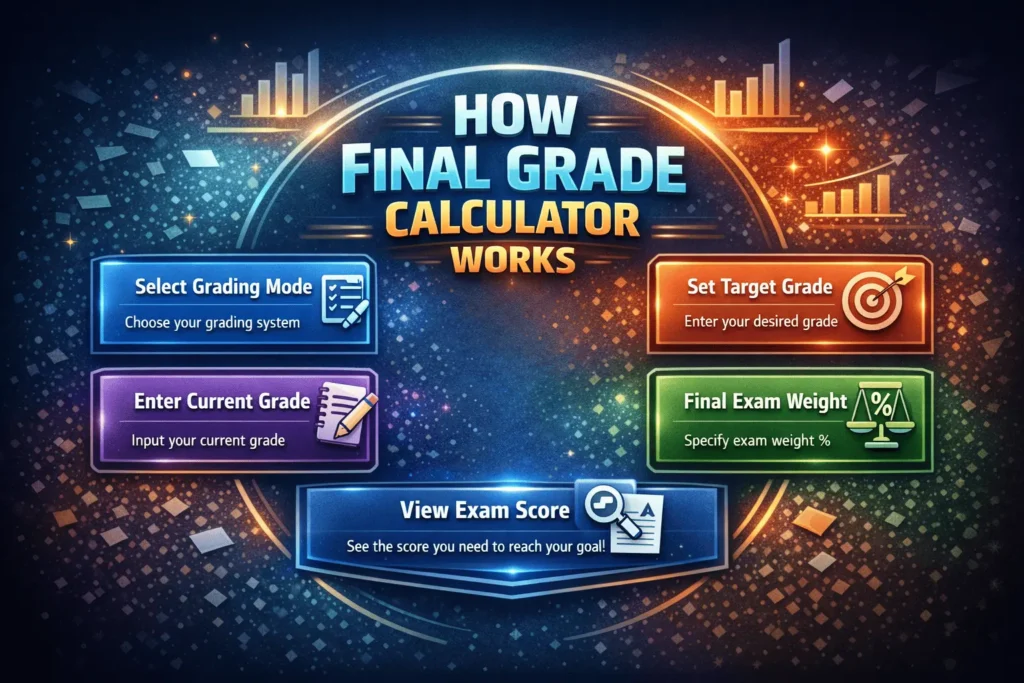
- Choose Your Grading Mode: Start by selecting the grading mode at the top of the calculator. You can choose Percentage if your grades are based on numeric scores, or Letters if your institution uses letter grades like A, B, or C. This option ensures accurate grade conversion.
- Enter Your Current Grade: In the Current Grade field, enter your existing course performance. This may include results from assignments, quizzes, midterms, and projects completed so far. Use an easy grader to convert quiz scores into percentages before entry. The calculator uses this value to measure your current academic standing
- Set Your Target Grade: Next, input your target grade the final grade you want to achieve in the course. This could be a specific percentage or a letter grade, depending on the selected mode. This step helps the calculator determine the score you need on your final exam to reach this goal.
- Add Final Exam Weight: Enter the final exam weight (%), which represents how much the final exam contributes to your overall grade. For example, if the final exam counts for 20% of the total grade, enter 20. This is a key factor in final grade calculation.
- View Required Final Exam Score: After entering all values, the tool instantly shows the score needed on the final exam. This helps students plan their study strategy, set realistic goals, and manage exam stress, while keeping track of their course performance
Example Calculations Using a Final Grade Calculator
See how different scenarios affect your required score on the final exam. These examples show what you need to reach your target grade.
Final Grade Calculator Formula
Percentage Mode Example
This example explains how percentage-based grading works by showing how current scores and exam weight affect the final course result.
| Example | Current Grade (%) | Target Grade (%) | Final Exam Weight (%) | Require Score (%) |
|---|---|---|---|---|
| 1 | 85 | 90 | 30 | 101.7 |
| 2 | 78 | 85 | 25 | 106 |
| 3 | 88 | 90 | 40 | 92.8 |
| 4 | 70 | 75 | 50 | 80 |
Letter Mode Example
This example explains how letter grades are used to calculate the required score on the final exam. It also shows how exam weight impacts whether a target grade is realistic.
| Current Letter Grade | Target Letter Grade | Final Exam Weight | Required Score |
|---|---|---|---|
| B+ (87%) | A (93%) | 20% | 117.0% |
| B (83%) | A- (90%) | 30% | 106.7% |
| B+ (87%) | A- (90%) | 25% | 99.0% |
| C+ (77%) | B (83%) | 40% | 92.0% |
| A- (90%) | A (93%) | 20% | 105.0% |
- B+ → A (20% weight) → 117% required
Not possible because the final exam only counts for 20% and the gap between the current and target grade is too large, pushing the required score above 100%. - B → A- (30% weight) → 106.7% required
Not possible because the final exam weight is not high enough to raise the overall grade to the target level. - B+ → A- (25% weight) → 99% required
Possible but very difficult because the required score is just under 100%, meaning nearly perfect performance is needed. - C+ → B (40% weight) → 92% required
Achievable because the final exam has a higher weight, allowing it to significantly impact the overall grade.
Tips to Achieve Good Grades in the Exam
Achieving good grades in the final exam requires smart time management, a clear study schedule, and understanding exam weight and grading criteria. Consistent preparation and focus on high-weight topics help improve overall exam performance.

- Why the Final Exam Shouldn’t Be a Hail Mary: Your final exam often counts as the largest portion of your class grade, but relying on it alone is not a smart strategy. From experience, the best way to keep grades high is by studying consistently and performing well in assignments and exams throughout the year. When you build a buffer early, the end of the semester feels less stressful, and your chances of earning high marks improve. While it’s still possible to ace the final, trying to save a class you’ve been slacking in would require either a time machine or better preparation starting next year.
- Build a Buffer Through Consistent Performance: Doing well throughout the semester helps keep your overall grade stable and reduces pressure at the end. Using an average grade calculator helps students monitor their ongoing performance throughout the semester and understand how consistent results contribute to building a strong grade buffer. Consistent study habits and steady performance in assignments and exams give you more control over your results. With a strong buffer in place, the final exam becomes less stressful because your grade does not depend on a single assessment.
- Create a Smart Study Schedule: To stay on track, you should create a study schedule that distributes time based on the weight of the final exam and your target grade requirements. Planning ahead allows you to manage your workload effectively and avoid last-minute cramming. A clear schedule ensures each subject receives attention according to its impact on your final grade.
- Identify Areas That Need the Most Improvement: It is important to identify the subjects where you need the most improvement to reach your desired grade. These are often the areas where a higher score on the final exam is required. By focusing on weaker topics, you can use your study time more efficiently and make meaningful progress toward your academic goals.
- Use Practice Exams to Adjust Strategy: Taking practice exams helps you understand your current level of preparation. They reveal strengths and highlight areas that still need work. Based on the results, you can adjust your study strategy and better align your preparation with your target course grade.
- Prioritize High-Weight Assessments: Study time should always be allocated in proportion to the weight of each assessment. Components that contribute more to your final grade deserve greater focus. This approach ensures that your effort matches how the course grade is actually calculated.
- Be Realistic With Extreme Grade Requirements: If a grade calculator shows that you need an extremely high score to achieve your goal, it may be time to rethink your plan. Seeking additional help can be useful, but it is equally important to adjust academic goals realistically. This helps reduce stress and encourages smarter planning for future courses.
Benefits of Using a Final Grade Calculator
Using a this Calculator provides multiple advantages for students, teachers, and educators, making it an essential academic tool.

- Time-Saving: Quickly calculates the final course grade, saving time for study or teaching.
- Accuracy: Automatically applies weightages for assignments, quizzes, midterms, projects, and the final exam, reducing errors.
- Predictive Analysis: Students can see the scores needed on assessments or the final exam to reach target grades.
- Track Academic Performance: Clear breakdown of grades helps monitor average grade and identify strengths and weaknesses.
- Stress Reduction: Shows required exam scores to reach desired grades, helping manage exam anxiety.
- Flexible Grading Systems: Works with percentage grades and letter grades, suitable for all academic programs.
- Goal Setting: Enables students to set realistic academic goals and track progress.
- Easy Decision Making: Helps prioritize subjects or topics to improve and reach target grades.
Limitations of Final Grade Calculator
Limitations of this final calculator explain the common issues that can affect accuracy when using a final grade calculator for a course. These limits show why results may not represent the actual academic status of a subject in real grading situations.
- Incomplete or Incorrect Data
If you don’t input accurate weights or grades while using any final grade calculator, the results might not represent your actual academic status in a subject. This is one of the most common issues, and being aware of it helps avoid confusion. - Changing Policies by Instructors
With Changing Policies, some instructors may curve scores or adjust grading policies mid-term. A calculator can't account for such unexpected changes, which means the estimate may no longer match reality. - Calculator Doesn’t Measure Understanding
A Calculator Doesn’t Measure Understanding because it only tells you the score you need. It doesn't help you get that score. It is simply a guide to help you strategize your studies, not a tool that improves learning. - Use It as Guidance, Not a Guarantee
While planning for finals, the Final Grade Calculator can be useful, but remember it’s not perfect. Good luck with your finals, and please let us know your feedback so the tool can improve.