16 Out of 18 Score Explained in Percentage and Grade

Many students feel confused after checking their test or quiz results. Even when the marks look good, it is not always clear what they actually mean. Sometimes teachers give scores instead of grades, which makes things harder to understand. This situation happens to students very often,so there is no need to worry.
Seeing a score like 16 out of 18 can leave you wondering about the percentage and the grade behind it. You may want to know if this result shows strong performance or just average effort. This article breaks everything down in a simple and stress-free way, so you can clearly understand your score without any confusion.By the end, you will feel confident about your result and know how it is usually judged in exams and quizzes.
What Is 16 Out of 18 as a Percentage?
A score of 16 out of 18 means you answered 16 questions correctly out of a total of 18.
When this score is converted into a percentage, it becomes 88.89%.
The 16/18 percentage comes out to 88.89%, which shows how much of the total score was achieved.Out of 18 questions, 2 questions were incorrect, or points were missed, which slightly reduced the final score but still kept the result well above average. This kind of score is commonly seen in a test score, quiz score, or assignment score, which reflects above average performance and shows a good understanding of the subject.
How to Calculate the Percentage

To calculate a percentage, we use a simple percentage conversion formula.
This formula helps change a score into a clear number that shows performance out of 100.
Formula:
Percentage = (Score ÷ Total) × 100
We divide the marks by the total because a percentage always shows how much of the whole was achieved.
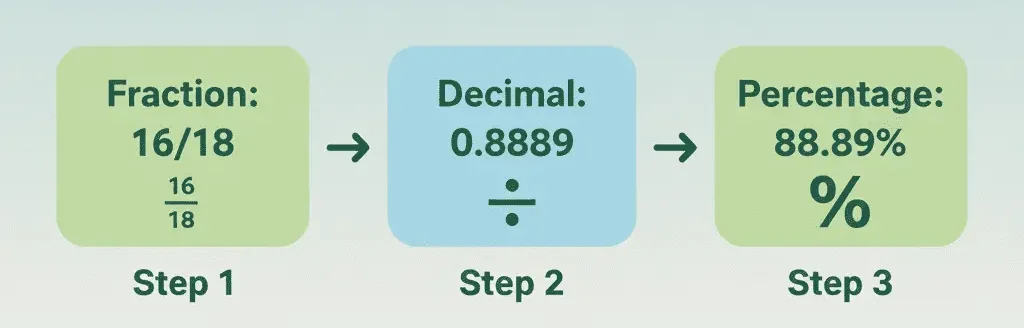
Step 1: Write the Score as a Fraction
- Write the score as a fraction 16/18, to show how many marks were obtained out of the total. 16 ÷ 18
- The top number represents the marks obtained, and the bottom number represents the total marks.
- This step shows the relationship between the achieved score and the total possible score.
Step 2: Divide to Get a Decimal
- Divide the obtained marks by the total marks. 16 ÷ 18 = 0.8889
- This converts the fraction into a decimal value.
- Decimal values are easier to work with when converting to percentages.
Step 3: Multiply by 100
- Percentages show scores out of 100 and are commonly used in academic grading.
- Multiply the decimal value by 100. 0.8889 × 100 = 88.89%
- This converts the decimal into a percentage.
Final Answer
After completing all the steps, the final percentage is 88.89%.
This means the score represents 88.89 percent of the total marks, showing a strong overall result.
Alternate Way to Find the Percentage
There is another simple method to calculate the percentage using the decimal approach. This method is helpful for students who find direct multiplication easier.
Method (Decimal Approach)
- Multiply the obtained score by 100. 16 × 100 = 1600
- Divide the result by the total number of questions. 1600 ÷ 18 = 88.89
- The final number is the percentage.
This method gives the same result because it follows the same math rules as the standard formula. Whether you divide first and then multiply, or multiply first and then divide, the final percentage does not change as long as the steps are done correctly.
Both methods follow the same order of division and multiplication, which is why the final percentage remains unchanged.
Decimal Form of the Score
The decimal value shows the score in another numeric form that is easy to read and compare. Instead of using fractions or percentages, decimals give a quick way to understand how close a score is to the full mark. For this score, the decimal form clearly shows that most of the total marks were achieved.
There is a direct relationship between decimals and percentages. A decimal can be turned into a percentage by moving it into a form out of 100. This is why decimals are useful in math grading and academic grading systems, where results are often compared, averaged, or analyzed.For example, converting 16/18 into a decimal shows how close the score is to the full mark.
Fraction to Percent Conversion Explained
A fraction shows a part of a whole by comparing two numbers. The top number tells how many parts are taken, and the bottom number shows the total number of equal parts. Fractions are commonly used in math and grading to represent scores and portions clearly.
To change a fraction into a percent, it follows a clear logical flow:
- Fraction – shows the relationship between the obtained part and the total whole
- Decimal – makes the value easier to work with and compare
- Percent – expresses the result out of 100 for clear grading and evaluation
First, the fraction is converted into a decimal, which simplifies the value. Then, the decimal is changed into a percent to show the result out of 100. This method works for all fractions, not just one specific example, and is widely used in exams, assignments, and academic results.
Grade Percentage and Letter Grade Explained
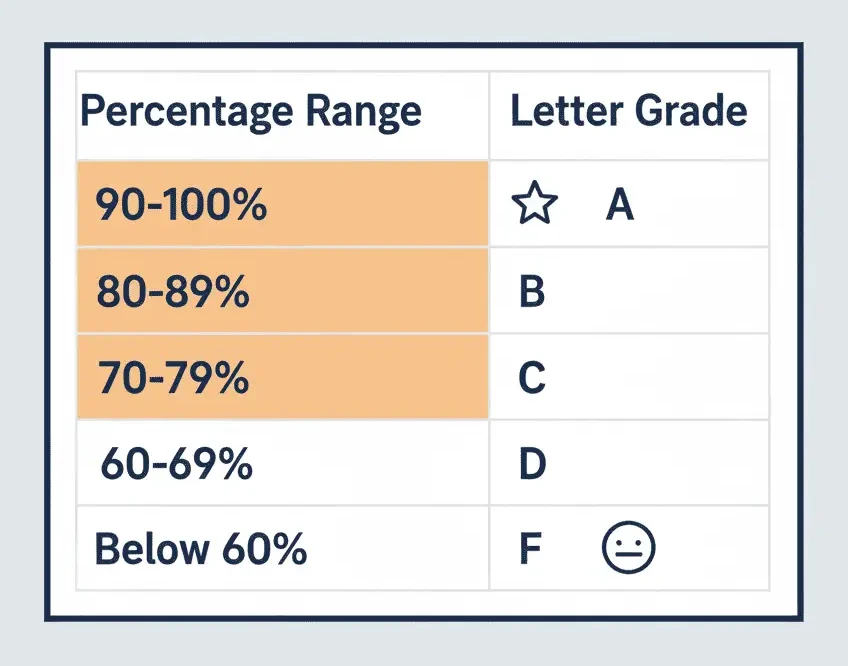
After calculating the final score, the next step is to understand how it is evaluated academically. Schools and colleges use a percentage grade and a letter grade to clearly show performance levels.A grade calculator can also help students quickly see how percentages convert into letter grades.Letter grades may vary slightly depending on the grading system used by a school or institution.This makes it easier to see where a result stands in the overall grading scale.
What Grade Does This Score Represent?
This score converts into a clear percentage grade, which helps explain academic performance in an easy way. Grading systems use percentages to decide how well a student performed compared to the total marks. Based on standard grading scales, the 16/18 grade usually falls in the B+ range.
88.89% (B+)
A result of 88.89% corresponds to a letter grade of B+.
This grade shows above average performance, meaning the student understood most of the material and answered the majority of questions correctly. It is a strong score, even though a small number of points were missed.
Letter Grades for an 18-Question Test
The table below shows how correct answers, incorrect answers, and percentage ranges relate to letter grades in an 18-question test.
| Letter Grade | Correct Answers | Incorrect Answers | Percentage Range |
| A+ | 17–18 | 0–1 | 97%–100% |
| A | 17 | 1 | 93%–97% |
| A- | 16–17 | 1–2 | 90%–93% |
| B+ | 16 | 2 | 87%–90% |
| B | 15–16 | 2–3 | 83%–87% |
| B- | 14–15 | 3–4 | 80%–83% |
| C+ | 14 | 4 | 77%–80% |
| C | 13–14 | 4–5 | 73%–77% |
| C- | 13 | 5 | 70%–73% |
| D+ | 12–13 | 5–6 | 67%–70% |
| D | 11–12 | 6–7 | 63%–67% |
| D- | 11 | 7 | 60%–63% |
| F | 0–11 | 7–18 | 0%–60% |
This table helps compare results quickly and understand how a percentage translates into a letter grade
Is 16 Out of 18 a Good Score?
Yes, 16 out of 18 is a good score in most learning situations. It shows a high level of score accuracy, meaning most answers were correct and only a few mistakes were made. This reflects strong understanding of the subject.
Such a result usually places a student in the high achievement range, which is viewed positively in schools and colleges. It shows steady effort and good preparation, even if it is not the maximum possible score.
So, this score represents positive academic results and indicates that the student is performing well compared to typical class expectations.In classrooms, teachers often use an easy grader to quickly check scores and accuracy.
Real-Life Example

Imagine a student takes a short test with 18 total questions. If the student answers 16 questions correctly, the score is recorded based on correct answers and total questions. This helps teachers measure performance in a clear and fair way.
When this score is reviewed, it is converted into a percentage grade to show how much of the test was completed successfully. That percentage is then matched with a letter grade, which gives a quick understanding of overall academic performance in exams, quizzes, or assignments.Teachers and students commonly use this method to quickly understand scores in everyday classroom settings.
Where Is This Percentage Calculation Used?
This type of calculation is commonly used in education to show results in a clear and standard way. It helps students and teachers understand performance by comparing achieved marks with the total possible marks.
- Exams – to show overall exam results based on marks obtained
- Quizzes – for quick scoring in short classroom tests
- Assignments – to evaluate student performance in written or practical work
- Assessments – to support fair performance evaluation across different subjects
Should the Result Be Rounded Up?
Many students get confused between 88.89 and 89. The difference happens because rounding changes a number to make it simpler, but it does not change the actual result. The exact value stays 88.89%, even if it is rounded for easy reading.
In most schools, academic rounding rules allow rounding to the nearest whole number only when needed. This is usually done for reports, summaries, or quick comparisons. However, when accuracy matters such as grading, calculations, or official records the exact percentage should be used instead of a rounded number.
Rounding is acceptable when the purpose is simple comparison or presentation. For precise evaluation and fair grading, keeping the original value gives a more accurate picture of student performance.
Percentage Table for Scores Out of 18
This table helps compare different scores out of 18 in a quick and clear way. It works as a reference table for understanding how small changes in marks affect the final percentage. This is useful for fast score comparison without doing calculations again.
| Score (Out of 18) | Percentage |
| 18 | 100% |
| 17 | 94.44% |
| 16 | 88.89% |
| 15 | 83.33% |
| 14 | 77.78% |
| 13 | 72.22% |
| 12 | 66.67% |
| 11 | 61.11% |
| 10 | 55.56% |
This table clearly shows the score distribution and makes it easy to see where a result stands compared to nearby scores.
Common Calculation Mistakes
Many students lose marks because of small calculation errors. Knowing these common mistakes helps avoid wrong results and improves accuracy.
- Wrong division – dividing the total by the score instead of dividing the score by the total
- Incorrect rounding – rounding too early and changing the final value
- Decimal confusion – mixing up decimal places and getting an inaccurate result.
- Fraction misunderstanding – placing numbers incorrectly when forming a fraction
- Calculation errors – mistakes during division or multiplication steps
Avoiding these errors leads to a more accurate percentage result and a clearer understanding of performance.
Understanding Percentages
A percent shows how much something is out of a whole of 100. The word percent means “per hundred,” which makes it easy to compare values using the same scale. This is why percentages are commonly used in schools to explain results clearly.
A percentage can also be written as a fraction by removing the percent symbol and placing the number over the denominator 100. This connection helps students understand how percentages relate to fractions and why they are useful for comparing scores in a simple and consistent way.
Summary
- Final percentage: 88.89%
- Letter grade meaning: B+
- Strong academic performance
- Commonly used in exams, quizzes, and assignments
Percentage-based scoring is a standard method used across schools to evaluate student performance fairly.
Related Percentage Calculations
If you’re checking similar scores, these related percentage calculations may also help you understand different results.
18/20 as percent
18 out of 25
14/18 percentage 15 out of 18
Conclusion
Now you clearly understand what your score means and how it is calculated. As promised, this article explained everything step by step, so there is no confusion left. A result like 16 out of 18 shows strong performance and reflects good understanding of the subject. In the future, you will be able to understand similar scores just as easily without any stress or confusion.
Frequently Asked Questions
What is 16 out of 18 as a percentage?
This score converts to 88.89%. This percentage shows how much of the total marks were achieved out of 100 and is considered a strong academic score.
How do I calculate 16 out of 18 using a calculator?
To calculate 16 out of 18, divide 16 by 18 and then multiply the result by 100. This gives 88.89%, which is the correct percentage value.
What grade is 16 out of 18?
A score of 16 out of 18 usually falls into the B+ grade range. It shows above-average performance and a good understanding of the subject.
How is 16 out of 18 written as a fraction?
As a fraction, the score is written as 16/18. This form shows the relationship between the obtained marks and the total marks.
Is 16 out of 18 a good score in math or exams?
Yes, its is considered a good score in most exams, including math tests. It means only a small number of points were missed and overall performance was strong.
Can 16 out of 18 be rounded to 89 percent?
The exact percentage is 88.89%. It may be rounded to 89% for simple presentation, but for accurate grading, the exact value is usually preferred.